


From Defense to Direction: Using the IIA’s Three Lines Model to Drive Stronger Risk Governance
Background
Risk governance is no longer about whether risks are being monitored. It is about whether leaders can act on the right risks fast enough. The Three Lines Model is a practical governance framework for turning emerging risk into executive-ready insight.
Keep reading further to find:
- A summary of the Three Lines Model.
- Best practices in using it from Centri’s risk advisory experts.
- Questions every audit committee should be asking.
Executive leaders and audit committees operate in an environment where disruption is no longer episodic; it is a standing condition for doing business. Technology transformation, artificial intelligence, cybersecurity, data governance, regulatory volatility, geopolitical uncertainty, third-party concentration, liquidity pressures, and heightened stakeholder expectations are increasingly interconnected.
These risks can affect strategy, performance, financial reporting, disclosure, reputation, and enterprise value at the same time. They can also change the reliability of information used in management reporting, the design and operation of internal controls, the assumptions underlying estimates and forecasts, and the judgments required for timely and transparent disclosures. As a result, risk management can no longer be viewed as a compliance exercise or a periodic control activity. It must be embedded into how leaders make decisions, allocate capital, evaluate transformation initiatives, oversee performance, and preserve trust.
The Institute of Internal Auditors’ Three Lines Model remains highly relevant in this environment because it helps boards, audit committees, and management clarify:
- Who owns risk.
- Who provides oversight and challenge.
- Who delivers independent assurance.
The shift from the former ‘Three Lines of Defense’ to the Three Lines Model reflects a more modern, principles-based approach. Governance should not be built only to defend against failure; it should enable calculated risk-taking, disciplined execution, timely escalation, and resilient performance.
Need Better Risk Governance?
Best Practices
A common misconception is that the Three Lines Model requires a rigid structure or applies only to large, mature public companies. Whether an organization is preparing to go public, building out a more formal control environment, or refining an existing governance structure, the priorities don’t change. Leaders should focus on clear accountability, effective communication, timely escalation, monitoring and challenge, and independent assurance where it matters most. For executive leaders and audit committees, the value of the model is not in creating more layers; it is in creating clarity. The model helps answer these practical oversight questions:
- Are the right risks visible to leadership?
- Are risk owners accountable?
- Are second-line functions providing meaningful challenge?
- Is internal audit focused on the risks that matter most?
- Are issues escalated quickly enough for leaders to act?
Effective risk governance starts with tone at the top, clear ownership, defined risk appetite, and a cadence of discussion that matches the pace of change. Boards and audit committees are increasingly expected to oversee not only financial reporting and compliance, but also how management identifies, prioritizes, and responds to risks that could affect strategy, enterprise value, reporting integrity, and disclosure readiness. Leading organizations are moving beyond annual, static risk assessments toward dynamic risk discussions, scenario analysis, risk dashboards, and early-warning indicators. Priority areas often include cyber resilience, AI governance, data quality and privacy, third-party and supply chain dependency, fraud risk, talent and capability gaps, liquidity and capital constraints, regulatory change, and the control implications of automation and transformation. The objective is to help leaders understand not only whether controls exist, but whether those controls remain fit for purpose as the business evolves and whether management can support accurate reporting, timely disclosure, and effective remediation when issues arise.
From an audit committee perspective, the most effective conversations connect risk to strategy, financial reporting, disclosure, and accountability. Committees should challenge whether management has defined ownership for emerging risks, whether risk tolerance is aligned to growth and transformation plans, and whether cyber and AI risks are being evaluated through both operational and control lenses. They should also confirm that internal audit and external assurance activities are focused on the areas of greatest consequence. They should also understand whether changes in systems, data, third-party service providers, and automated controls have been assessed for their impact on ICFR, disclosure controls and procedures, key reports, and investor-facing communications.
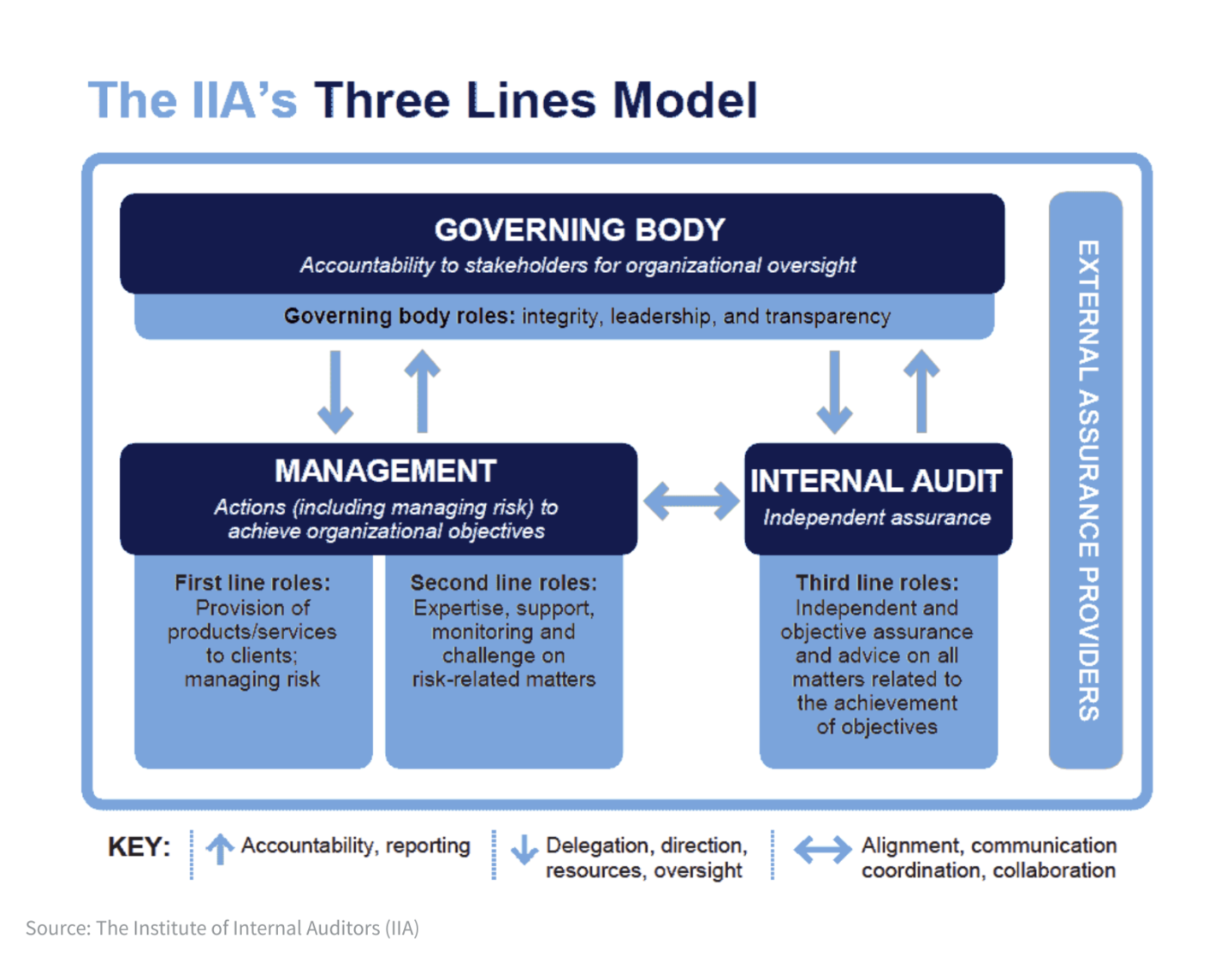
The Three Lines Model provides a practical way to organize governance without creating unnecessary bureaucracy. The governing body provides oversight and sets expectations for transparency, ethics, accountability, and performance. Management leads and directs actions to achieve objectives. First-line roles own and manage risks through day-to-day operations and business decisions. Second-line roles provide expertise, frameworks, monitoring, and constructive challenge. Internal audit provides independent assurance and advice on whether governance, risk management, and controls are designed and operating effectively. The model is most effective when tailored to the organization’s size, maturity, risk profile, operating model, and assurance needs.
The IIA’s Three Lines Model
First-Line Responsibilities
First-line responsibilities sit with the management roles closest to strategy execution, operations, systems, transactions, data, and customer or stakeholder commitments. These roles are responsible for identifying and managing risk in the decisions they make every day, including risks introduced through new technology, process changes, AI-enabled tools, outsourced service providers, and evolving business models. First-line leaders should understand the risks they own, the controls they rely on, the data used to measure performance and financial reporting, the reports used to support disclosures, and the thresholds that require escalation.
In practice, this may include review of high-risk transactions, user access and segregation of duties, and validation of key reports and data inputs. It can also involve oversight of third-party outputs, monitoring of control exceptions, review of AI-enabled process changes, and timely remediation of control gaps.
It also includes understanding whether control failures, data quality issues, system changes, or process redesigns could affect financial statements, management certifications, disclosure timelines, or the reliability of information provided to executives and the audit committee. For executives and audit committees, the key question is whether business owners can clearly explain their most important risks, how those risks are controlled, when issues are escalated, and whether reporting and disclosure implications have been considered.
Second-Line Responsibilities
Second-line responsibilities are also management roles, but they are distinct from first-line ownership. These roles provide complementary expertise, frameworks, monitoring, and challenge over the management of risk. Depending on the organization, second-line functions may include controllership, compliance, legal, enterprise risk management, cybersecurity, information security, privacy, sustainability, quality assurance, or other risk-focused functions.
In today’s environment, second-line teams play an increasingly important role in helping management translate emerging risks into practical policies, standards, risk assessments, metrics, and control expectations. They also help leadership evaluate whether risk management activities are keeping pace with technology change, regulatory expectations, operational complexity, financial reporting requirements, disclosure obligations, and stakeholder scrutiny.
For many organizations, especially smaller, newly public, acquisitive, or high-growth companies, responsibilities may overlap. That overlap does not mean the model cannot be applied. It does mean management should be intentional about defining decision rights, documenting monitoring and challenge activities, identifying objectivity concerns, and establishing escalation paths, particularly where activities affect ICFR, disclosure controls and procedures, key reports, or remediation of control deficiencies. Audit committees should ask where overlap creates efficiency, where it creates blind spots, and whether management has enough capability and independence to provide credible challenge.
Internal Audit Function
Internal audit provides independent and objective assurance and advice to management and the governing body on the adequacy and effectiveness of governance, risk management, and controls. In today’s environment, internal audit’s value increases when its plan is risk-based, forward-looking, and connected to the organization’s strategy and most consequential risks. This may include assurance over cyber resilience, third-party risk, AI governance, data quality, financial reporting controls, disclosure controls and procedures, regulatory readiness, fraud risk, remediation, and transformation initiatives.
Internal audit can also help evaluate whether changes in systems, processes, data flows, and service providers have been appropriately considered in relation to reporting integrity, disclosure readiness, and control effectiveness.
Unlike first- and second-line roles, internal audit maintains independence from management responsibilities and primary accountability to the governing body. This independence enables internal audit to provide an objective view of whether key risks are being identified, escalated, and addressed in support of organizational objectives. Internal audit should also report impairments to independence or objectivity to the governing body and implement safeguards, as needed.
External Assurance Providers
External assurance providers can complement the organization’s internal assurance activities, particularly where specialized expertise or independent validation is needed. These providers may deliver assurance to satisfy legislative, regulatory, investor, customer, or stakeholder expectations, or to address specific requests from management or the governing body.
Depending on the organization’s risk profile and assurance needs, external assurance providers may include external auditors, regulators, service auditors, cybersecurity specialists, privacy specialists, valuation experts, or other independent advisors. They can also provide assurance or specialized input over areas that directly support financial reporting and disclosure, such as service organization controls, cybersecurity program assessments, regulatory compliance, valuation assumptions, tax matters, or other areas requiring subject-matter expertise. Audit committees should understand how external assurance is coordinated with internal audit and management monitoring to reduce duplication, close assurance gaps, and maintain a clear view of residual risk.
Why This Matters Now
The pace and correlation of risk have changed the expectations placed on executive leaders and audit committees. Cyber incidents can create disclosure questions, AI adoption can introduce data and control risks, third-party failures can disrupt operations and reporting dependencies, and regulatory developments can quickly affect governance expectations. In this environment, leaders need more than periodic updates. They need a clear view of risk ownership, timely escalation, and credible challenge, along with assurance coverage that is aligned to the risks most likely to affect strategy, financial reporting, disclosure, reputation, and enterprise value.
The Three Lines Model helps create that clarity. When applied effectively, it gives leaders conviction that risks are not only being identified, but are being owned, monitored, challenged, escalated, and independently assessed. That confidence is especially important as organizations navigate transformation, public company readiness, remediation, cybersecurity threats, AI-enabled processes, heightened stakeholder scrutiny, and the need to support reliable financial reporting and timely, transparent disclosure.
Questions Audit Committees Should Be Asking
Audit committees continue to play a critical role in overseeing financial reporting, internal controls, compliance, and assurance. However, their risk oversight responsibilities have expanded as cyber, AI, third-party, regulatory, and transformation risks increasingly affect reporting, disclosure, operations, and enterprise value.
This connection matters because emerging risks can change the reliability of data used in financial reporting, introduce new control dependencies, affect significant estimates and judgments, create fraud or access risks, and trigger disclosure considerations. These are some suggested questions to help committees challenge whether management has the right governance in place to support timely, informed oversight.
- Who owns our most significant emerging and enterprise-level risks?
- Where do first- and second-line responsibilities overlap, and where could that overlap create gaps or blind spots?
- How does management know risk reporting is complete, timely, and decision-ready?
- Are cyber, AI, third-party, transformation, and regulatory risks reflected in our assurance plan?
- Are financial reporting, disclosure, fraud, and control risks being evaluated as business processes evolve?
- Are changes in systems, data flows, service providers, or automated processes being evaluated for their impact on ICFR and disclosure controls and procedures?
- Do management’s risk assessments consider how emerging risks could affect significant accounting estimates, forecasts, impairment analyses, liquidity disclosures, cyber disclosures, and other investor-facing communications?
- Do escalation protocols enable leadership to act quickly when risk indicators move outside tolerance?
- Are remediation efforts progressing with the urgency and accountability expected by leadership and the audit committee?
In today’s environment, organizations do not need more governance for governance’s sake. They need risk governance that helps leaders see around corners, act with confidence, demonstrate accountability, and support reliable reporting and disclosure when risk conditions change.
How Centri Can Help
A well-designed Three Lines Model helps executive leaders and audit committees move from reactive issue management to proactive, risk-informed governance by clarifying ownership, oversight, challenge, escalation, and assurance. It also helps leadership connect risk discussions to strategy, performance, financial reporting, disclosure, and stakeholder confidence. This means making clear how operational, technology, compliance, and third-party risks may affect ICFR, disclosure controls and procedures, management reporting, fraud risk, estimates and judgments, and external communications.
Centri helps organizations apply the Three Lines Model in a practical, scalable way that reflects today’s governance expectations. Our teams work with management, audit committees, internal audit functions, and other stakeholders to assess current governance and risk management structures. We help clarify first- and second-line responsibilities, define monitoring and challenge activities, preserve internal audit’s independence, and identify how external assurance providers complement internal sources of assurance.
We help organizations develop risk dashboards, governance charters, role and responsibility matrices, escalation protocols, internal audit plans, control documentation, remediation roadmaps, and audit committee reporting. These deliverables are aligned to strategy, risk appetite, regulatory expectations, financial reporting priorities, and organizational maturity. This includes helping organizations evaluate how emerging risks may affect ICFR, disclosure controls and procedures, key reports and data, significant estimates and judgments, fraud risk, remediation status, and management’s ability to provide timely, decision-useful information to the audit committee. Whether an organization is preparing for public company readiness, responding to emerging cyber or AI risks, remediating control gaps, or refining an existing governance model, Centri can help leaders build a clearer, more resilient, and more decision-useful risk governance framework.
Editor’s note: This article was originally published in 2019. It was updated on August 7, 2026.
About Centri Business Consulting, LLC
Centri Business Consulting provides the highest quality advisory consulting services to its clients by being reliable and responsive to their needs. For 15 years, Centri has delivered trusted expertise to help companies meet their evolving reporting demands. Centri specializes in financial reporting, internal controls, technical accounting research, outsourced accounting, valuation, mergers & acquisitions, and tax, CFO and HR advisory services for companies of various sizes and industries. From complex technical accounting transactions to monthly financial reporting, our professionals can offer any organization the specialized expertise and multilayered skillsets to ensure the project is completed timely and accurately.
3 Logan Square
26th Floor
1717 Arch Street
Philadelphia, PA 19103
530 Seventh Avenue
Suite 2201
New York, NY 10018
4509 Creedmoor Rd
Suite 206
Raleigh, NC 27612
50 Milk St.
18th Floor
Boston, MA 02109
1775 Tysons Blvd
Suite 4131
McLean, VA 22102
One Tabor Center
1200 17th St.
Floor 10
Denver, CO 80202
615 Channelside Drive
Suite 207
Tampa, FL 33602
1175 Peachtree St. NE
Suite 1000
Atlanta, GA 30361
1920 McKinney Avenue
Dallas, TX 75201
8481 Jefferson Hwy.
Minneapolis, MN
55369-4588